The post Glenn’s Technical Insights For December 3, 2019 appeared first on Glenn Berry.
]]>Intel Releases Cascade Lake-X HEDT Processors
On November 25, Intel released their new line of 14nm high-end desktop (HEDT) processors which is the Cascade Lake-X family. This is the latest iteration of Intel’s Core X-series Processors which have traditionally been their most expensive non-Xeon processors. This release includes four SKUs, ranging from 10C/20T up to 18C/36T.
Intel Core i9-10980XE 18C/36T $979.00
Intel Core i9-10940X 14C/28T $784.00
Intel Core i9-10920X 12C/24T $689.00
Intel Core i9-10900X 10C/20T $590.00
These prices are roughly 50% lower than the previous generation Skylake-X Refresh HEDT processors. Given Intel’s poor competitive position right now, a large price cut was about they best they could do to try to make this release more attractive. Even a 50% price cut doesn’t actually seem to be enough given the benchmark results for these processors.
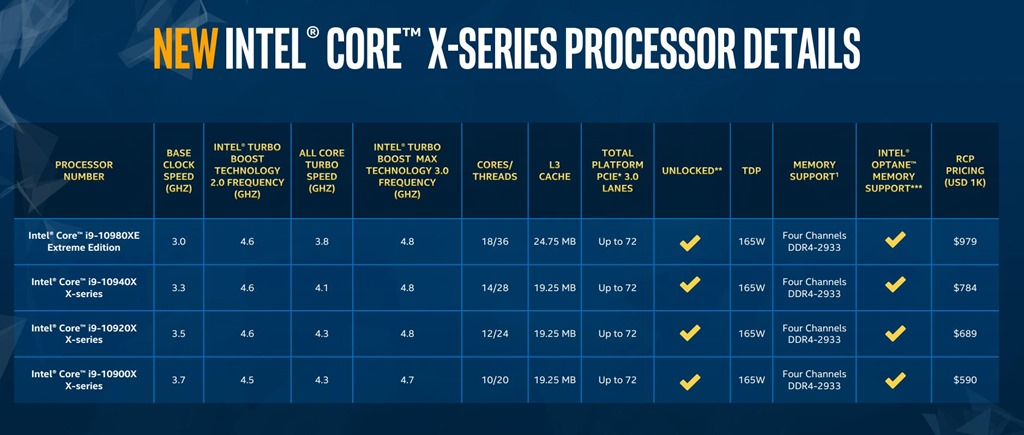
Figure 1: Intel Cascade Lake-X Details
Interestingly, there is no 16C/32T SKU in this generation (which would replace the previous generation Core i9-9960X). I think it is pretty likely that Intel purposely skipped that SKU because it would not compare very well to the new 16C/32T AMD Ryzen 9 3950X.
The reviews (and benchmark results) for these four new HEDT processors have been almost universally negative. These processors use the pretty ancient X299 chipset, which is lacking several modern features. What is really bad for Intel is that their new “flagship” Core i9-10980XE HEDT processor is beaten by the new AMD Ryzen 9 3950X mainstream desktop processor in many benchmarks, even though it costs about $200 more. It is also completely dominated by the new, more expensive 7nm AMD Ryzen Threadripper 3960X and 3970X HEDT processors in most benchmarks.
Here are a few reviews:
- It’s a Cascade of 14nm CPUs: AnandTech’s Intel Core i9-10980XE Review
- Intel Core i9-10980XE Review: Intel Loses its Grip on HEDT
- Ryzen 9 3950X vs. Entire Intel Cascade Lake-X Lineup, Core i9-10900X, 10920X, 10940X & 10980X
Conclusion
In my mind, there are really not too many scenarios where these processors would be a good choice for a new machine build. They do not compare well to to the less expensive mainstream desktop Ryzen 9 processors for single-threaded or multi-threaded performance (or platform features). They also do not fare very well against the more expensive 3rd Generation AMD Threadripper processors for more serious content creation workloads.
I would argue that semi-serious content creators would be better off with a 12C/24T AMD Ryzen 9 3900X or a 16C/32T AMD Ryzen 9 3950X instead of any of these Cascade Lake-X processors. If you literally make your living off of content creation tasks, it is an easy decision to step up to a 3rd Generation AMD Threadripper system.
The post Glenn’s Technical Insights For December 3, 2019 appeared first on Glenn Berry.
]]>The post Glenn’s Technical Insights For November 17, 2019 appeared first on Glenn Berry.
]]>New Intel Processor Security Vulnerabilities Revealed
Intel has disclosed two new processor security vulnerabilities, including the TSX Asynchronous Abort (TAA) issue and a Jump Conditional Code (JCC) Erratum. These two issues affect most recent Intel processors, including the most recent Intel Cascade Lake-SP server processors.
The continued emergence of these types of issues (and the firmware and software fixes required to mitigate them) has an increasing negative effect on the performance of Intel processors.
Intel Reveals TAA Vulnerabilities in Cascade Lake Chips and a New JCC Bug
Zombieload V2 TAA Performance Impact Benchmarks On Cascade Lake
Deep Dive: Intel® Transactional Synchronization Extensions (Intel® TSX) Asynchronous Abort
Microsoft’s official guidance for SQL Server for these types of issues is here. Microsoft has released a KB article that shows how to change a Registry setting to disable TSX (which is one way to prevent the TAA issue).
Microsoft Offers New Azure VMs Running AMD EPYC 7002 Processors
Microsoft recently introduced fourth-generation D-series instances (Da_v4 and Das_v4) which target enterprise-grade applications, relational databases, in-memory caching and analytics. These VMs use 32C/64T AMD EPYC 7452 processors that support up to 96 vCPUs, 384GB of DDR4 RAM and 2.4TB of SSD-based temporary storage for each VM.
Microsoft has new fourth-generation E-series VMs (Ea_v4 and Eas_v4) that target business-critical workloads that need large amounts of memory. These VMs also run on AMD EPYC 7452 processors, supporting up to 96 vCPUs, 674GB of DDR4 RAM and 2.4TB SSD-based temporary storage for each VM.
The Das_v4 and the Eas_v4 series offer premium SSD managed disks, which have much better performance for I/O intensive workloads, such as SQL Server.
Microsoft also has Azure NVv4 instances for virtual desktops using the 64C/128T AMD EPYC 7742 processor and AMD Radeon Instinct MI25 GPUs. AMD had an announcement about this during the Ignite conference.
The post Glenn’s Technical Insights For November 17, 2019 appeared first on Glenn Berry.
]]>The post Glenn’s Technical Insights For November 4, 2019 appeared first on Glenn Berry.
]]>AMD and Intel Financial Results for Q3 2019
Normally the financial results of tech companies is not that interesting (unless you work there or own stock in the company). In this case, looking at how AMD and Intel are doing, and comparing their relative size is relevant from an technical perspective since it may help you understand what they are doing with their products and pricing.
AMD has had their best financial quarter since 2005, with 1.8 billion dollars in revenue, and while this sounds impressive, they are still dwarfed by Intel with 19.2 billion dollars in revenue for the quarter. From a net earnings perspective, the picture is even more in Intel’s favor, with Intel posting 6.0 billion in GAAP net income, while AMD posted 120 million in net income for the quarter.
There are a couple of reasons why this matters. First, a resurgent AMD will have more money available for R & D and new product development than they did in the past, which will allow them to maintain their competitive pressure on Intel. On the other hand, Intel has the financial resources and very high margins that will let them lower prices in order to maintain their market share. In the recent past, they haven’t had to do this due to lack of competition from AMD in most market segments.
Since the release of the Zen 2 architecture (with the Ryzen 3000 series desktop processors and EPYC 7002 series server processors), AMD has been reclaiming some market share in those two segments. They have also done well with the Ryzen Threadripper 2000 series HEDT processors, and should do even better with upcoming Zen 2 based Ryzen Threadripper 3000 series HEDT processors. Intel is still doing very well in the mobile segment, which is very important to them.
We have already seen a pretty massive price decrease (over 50%) with the new Intel Cascade Lake-X HEDT processors, as I discussed here. There are pretty strong rumors that Intel is going to announce some price cuts on their mainstream desktop processors pretty soon. I wouldn’t be too surprised to see Intel announce some official price cuts on their Xeon processors in the next few months.
The point here is that AMD has developed into a serious competitor in the mainstream desktop, HEDT, and server market, while Intel is maintaining their dominance in the mobile market. This relative weakness in some segments has already caused Intel to reduce prices on some products, and their financial resources will allow them to do more of that if they want to. Intel has actually touted their financial strength as a key competitive advantage vs. AMD, which makes it even more likely they will announce price cuts on more products. This is good for consumers, but perhaps not so much for Intel stockholders.
AMD AGESA 1.0.0.4 Begins Rolling Out for Ryzen 3000 Series Processors
AGESA stands for AMD Generic Encapsulated Software Architecture. This is a procedure library that AMD developed and maintains, that is supplied to their partner motherboard vendors for use as part of the BIOS of the motherboard. AMD periodically releases new AGESA versions that contain bug fixes and performance enhancements. The motherboard vendors then take this AGESA code and incorporate it into a new BIOS version that you have to download and install on your system.
Even though this may sound trivial, it is actually pretty important if you want to get the best performance and reliability out of your system. Keeping your BIOS up to date is important, whether is is for your laptop, gaming machine, or database server. AGESA 1.0.0.4 improves system boot times by 20-30%, improves turbo clock speed performance and improves NVMe device compatibility, on top of having many other small bug fixes. If you have an AMD desktop system, you should check with your motherboard vendor over the next couple of weeks to get an updated BIOS.
This reminds me of how Tesla pushes out free OTA software updates. They recently pushed out version 2019.36.1, which included a 5% peak power increase for the Model 3, among other new features and improvements. This is the second 5% power increase they have enabled with a software update. Getting extra performance for free is a great thing, whether it is for your car or for your computer.
Intel Delays Release of Cascade Lake-X HEDT Processors
According to WCCFTech (which has a somewhat mixed record regarding rumors and leaks), Intel has decided to slightly delay the planned release of Cascade Lake- X from November 5 to November 25. The supposed reason for this is so Intel can see the pricing for the upcoming AMD Ryzen Threadripper 3000 series HEDT processors, and then decide whether they want to make any pricing adjustments to Cascade Lake-X.
Speaking of that, AMD has scheduled a “Meet The Experts” webinar on November 6, 2019, where they will cover “AMD plans for high-end desktop systems” and “The future of the high-end desktop market”, meaning it is pretty likely they will release more information about the AMD Ryzen Threadripper 3000 series during the webinar.
The post Glenn’s Technical Insights For November 4, 2019 appeared first on Glenn Berry.
]]>The post Glenn’s Technical Insights For October 23, 2019 appeared first on Glenn Berry.
]]>AMD Threadripper 3000 Series
More information has been leaking regarding the upcoming release of the 3rd generation, Zen 2 AMD Ryzen Threadripper 3000 processors. These 7nm HEDT processors are supposed to be officially announced on November 5, 2019, and two of the SKUs are rumored to be available for sale on November 19, 2019. The series will start with a 24C/48T Ryzen Threadripper 3960X and a 32T/64C Ryzen Threadripper 3970X. These will be accompanied by new TRX40 chipset motherboards that will be available at the same time.
The initial announcement and release will be followed by one or two higher-end SKUs that will be released in January 2020. These would be the 48C/96T Ryzen Threadripper 3980X and the flagship 64C/128T Threadripper 3990X. So far, we don’t know other specifications like clock speeds, cache sizes, or how much IPC gain these processors will have compared to the previous 2nd generation Threadripper processors. They are supposed to have PCIe 4.0 support, and will likely have more PCIe lanes and higher memory capacity than their predecessors.
Needless to say, I am pretty excited about 3rd Generation Threadripper. I think it is going to extend AMD’s dominance in the HEDT market. The “entry-level” 7nm 24C/48T AMD Ryzen Threadripper 3960X HEDT processor should compare very favorably with the recently released “high-end” 14nm 18C/36T Intel Core i9-10980XE Extreme Edition HEDT processor. The AMD processor will definitely have better multi-threaded performance, as you would expect from having 24 vs. 18 cores.
It is also likely to have better single-threaded performance than Intel. It will also have more PCIe bandwidth (from a combination of Gen 4 support and having more total lanes). The AMD processor will probably cost about the same as the Intel processor, and it will be using a more modern, feature-rich TRX40 chipset compared to Intel’s refreshed X299 chipset. This is pretty amazing, with the entry-level AMD HEDT SKU beating the high-end Intel HEDT SKU in nearly every measure.
Building one of these very powerful desktop machines is still going to be fairly expensive, typically in the $3000-$5000 range depending on exactly what components you choose. That is a lot of money, but for people who actually make money using the full horsepower of a HEDT machine, it will be worth it. If you don’t need that much horsepower, you will also have another, less expensive choice from AMD
AMD Ryzen 9 3950X Processor
Intel’s woes will continue when the 16C/32T AMD Ryzen 9 3950X mainstream desktop processor is released in November. This is the flagship Zen 2 desktop processor that has a base clock speed of 3.5GHz, a max boost clock speed of 4.7GHz and 64MB of L3 cache. AMD is said to be binning better quality Zen 2 processor cores for the $749.00 flagship 3950X compared to the lower-end SKUs in that product family. This means that they will reliably run at higher max boost speeds more often.
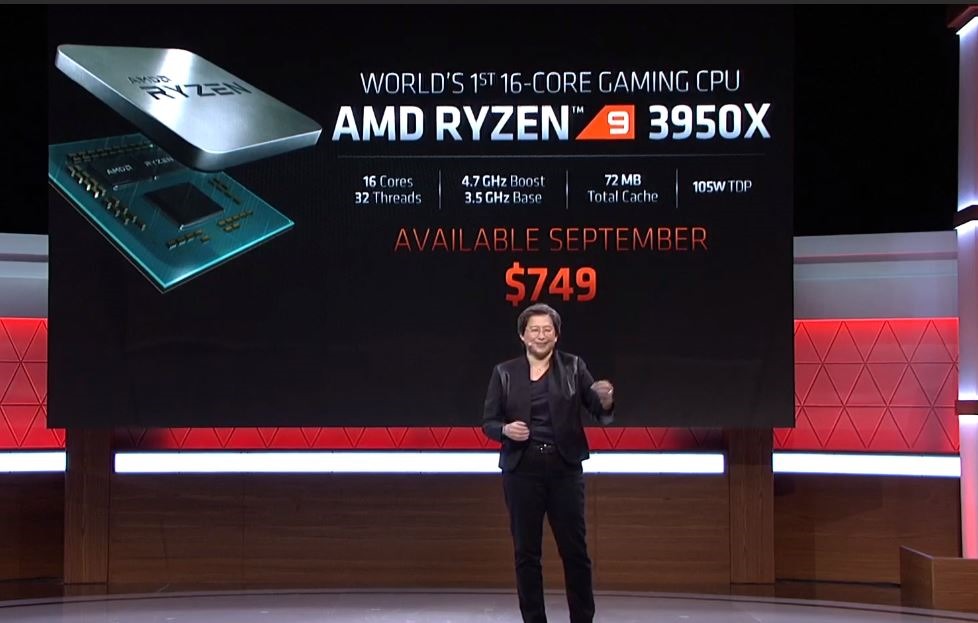
Figure 1: AMD Ryzen 9 3950X
Another advantage is that Zen 2 has been out since July 7, 2019, so there has been time for AMD to improve the AMD Generic Encapsulated Software Architecture (AGESA) firmware and their chipset drivers compared to the initial release versions, which has improved performance. Remember, you want to make sure you have the latest BIOS version, latest AMD chipset drivers, and Windows 10 Version 1903 (or later) to get the best performance from a Zen 2 processor.
There have been some leaked benchmarks showing the mainstream Ryzen 9 3950X beating the HEDT Intel Core i9-10980XE processor. These leaked benchmarks are not on exactly comparable systems (with different video cards and different memory speeds), so keep that in mind.
The bottom line for me is that for most desktop workloads, you can get much better overall performance for much less money with an AMD Zen 2 system compared to an Intel system. One exception is 1080P gaming, where your video card is not a bottleneck. In this scenario, the fastest, most expensive Intel desktop processors, such as the Intel Core i9-9900K and upcoming Intel Core i9-9900KS will have higher frame rates on some, but not all games. If you are gaming at 2K or 4K, you will be better off with a more affordable AMD Ryzen 7 3700K, and then spending the money you saved on the processor on a better video card.
For general desktop usage and content creation scenarios, having more cores (such as the 12C/24T AMD Ryzen 9 3900X or the 16C/32T AMD Ryzen 9 3950X) is going to be much more useful most of the time. If you are on a budget, the 6C/12T AMD Ryzen 5 3600 or the 8C/16T AMD Ryzen 7 3700X are excellent choices.
The post Glenn’s Technical Insights For October 23, 2019 appeared first on Glenn Berry.
]]>The post Glenn’s Technical Insights For October 11, 2019 appeared first on Glenn Berry.
]]>Microsoft SQL Server Cumulative Updates
Microsoft has recently released (and then removed) SQL Server 2016 SP2 CU9. There was nothing wrong with the actual payload of SQL Server 2016 SP2 CU9, but there was a problem if you tried to uninstall it. To be fair, uninstalling a CU doesn’t happen that often, but if you want/need to do it, it should work properly. It was quickly replaced with SQL Server 2016 SP2 CU10, which is identical to CU9, except that the uninstall issue has been fixed. Since SQL Server 2016 SP1 is no longer supported, there was no CU for that branch.
Microsoft also released SQL Server 2017 CU17 on October 8, 2019. This is Build 14.0.3238.1, with 34 public hotfixes. So far, there are no reported issues with this CU. I wrote more about this CU here. Despite some recent stumbles by Microsoft, I am still a big proponent of trying to keep your SQL Server instances as up to date as possible. That does not mean throwing a new CU into Production the day it is released, but it also does not mean avoiding patching SQL Server indefinitely either.
Intel Cascade Lake-X HEDT Processors
On October 7, 2019, Intel released a new line of high end desktop (HEDT) processors for the existing X299 chipset. This is the 14nm Core i9-10900 Series that is meant for HEDT and workstation usage on the LGA2066 platform on existing X299 and new X299X motherboards. There are four SKUs in this release, ranging from 10C/20T up to 18C/36T.
These processors have slightly higher base and Turbo Boost clock speeds than the previous Skylake-X HEDT processors, with support for up to 256GB of DDR4-2933 memory. They also have several other minor improvements compared to Skylake-X. Overall, the majority of the enthusiast tech community seems to be pretty underwhelmed by this product family.
The big news with this release is a rather dramatic price reduction compared to Skylake-X, especially on the higher core count SKUs. For example, the new 18C/36T Core i9-10980XE has a launch price of $979.00 compared the previous 18C/36T Core i9-9980XE that went for about $2000.00.
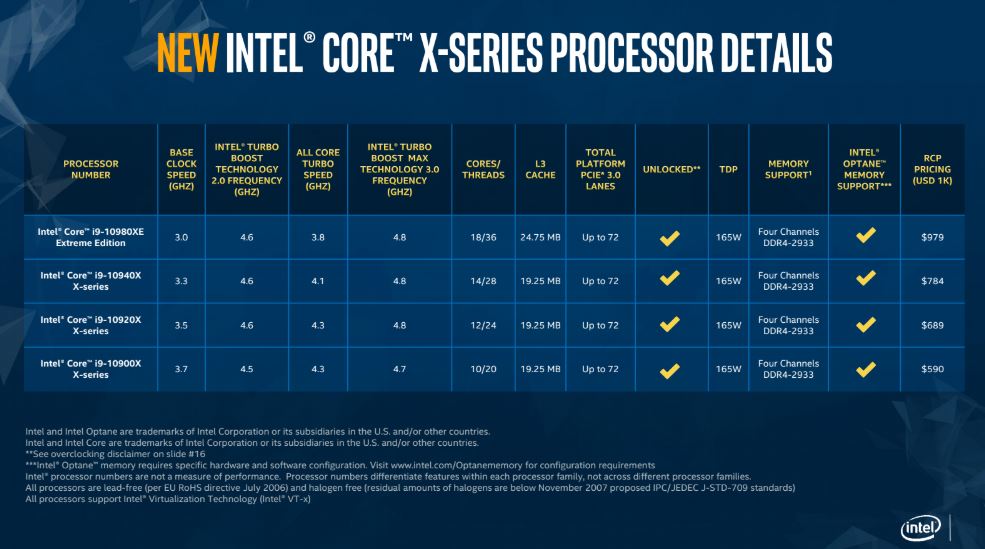
Figure 1: Intel Core i9-10900 Series SKUs
These price cuts seem to be a pretty obvious response to what AMD has been doing over the past year (and what they are going to release in November). AMD is due to release the 7nm 16C/32T mainstream desktop Ryzen 9 3950X for $750.00 in November, along with the 7nm 3rd Generation Threadripper processors. The 3rd Generation Threadripper processors are rumored to have between 24C/48T at launch, up to possibly 64C/128T later. There are also strong rumors of new TRX40 and TRX80 chipsets that may have additional memory channels and more PCIe 4.0 lanes compared to 2nd Generation Threadripper. We don’t know clock speeds or pricing yet.
This is another example of why viable competition between Intel and AMD is good for the market and for consumers. AMD seems to be winning a lot of battles in different market segments lately, but Intel has many talented engineers and lots of resources that they can throw into the fight. Intel will eventually have a better response than drastic price cuts, so this will be an interesting fight over the next couple of years.
The post Glenn’s Technical Insights For October 11, 2019 appeared first on Glenn Berry.
]]>The post Glenn’s Technical Insights For September 26, 2019 appeared first on Glenn Berry.
]]>
Useful Utility/Benchmark Software Updates
Samsung has released a new version of Samsung Magician, which is now version 6.0. This release has a completely new user interface, and quite a bit of additional functionality. I have noticed that it takes longer to startup and scan your drives compared to the previous version. If you have any Samsung SSDs in your system, you really should have their Magician software, especially for obtaining and installing firmware updates.
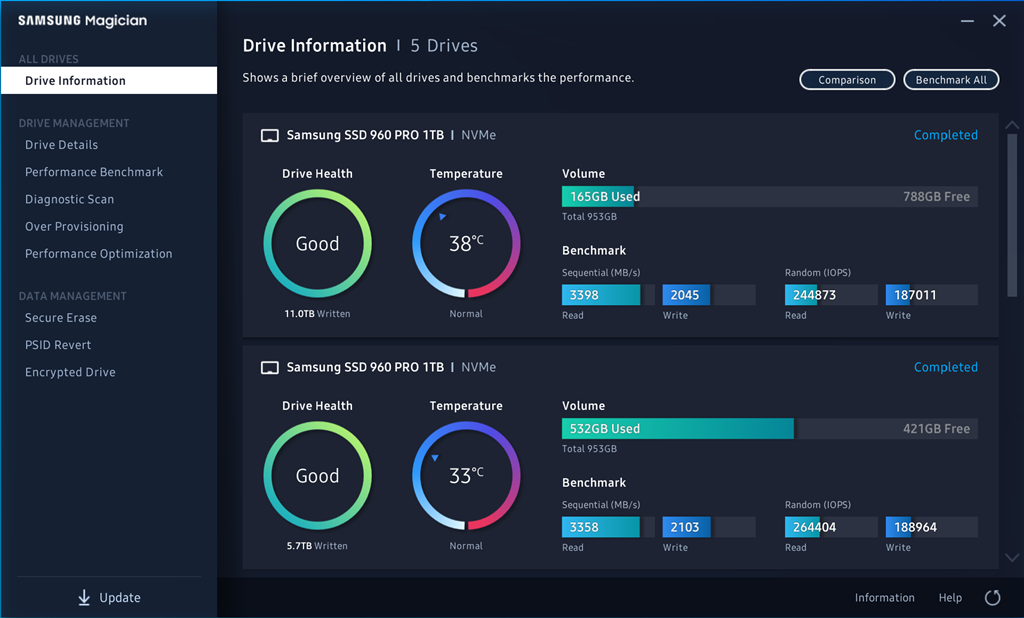
Figure 1: Samsung Magician 6.0
CrystalDiskMark 7 Beta 4 is available, with many new features along with additional testing and display modes. These include displaying IOPS and latency information in the main GUI.
You can also choose from different testing profiles, which essentially let you do similar testing compared to running Microsoft DiskSpd natively. This is going to make CDM a much more useful tool.
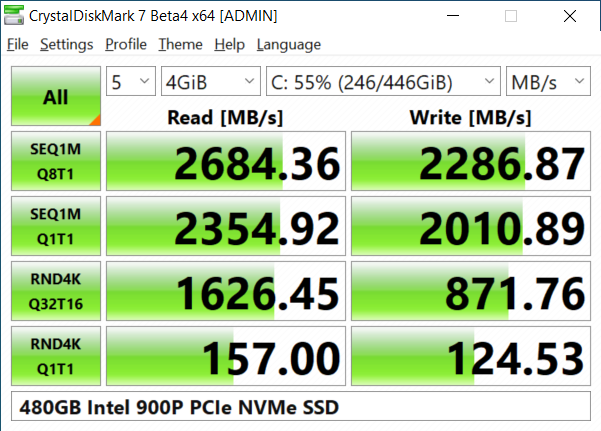
Figure 2: CrystalDiskMark 7.0 Beta4 – Default Profile
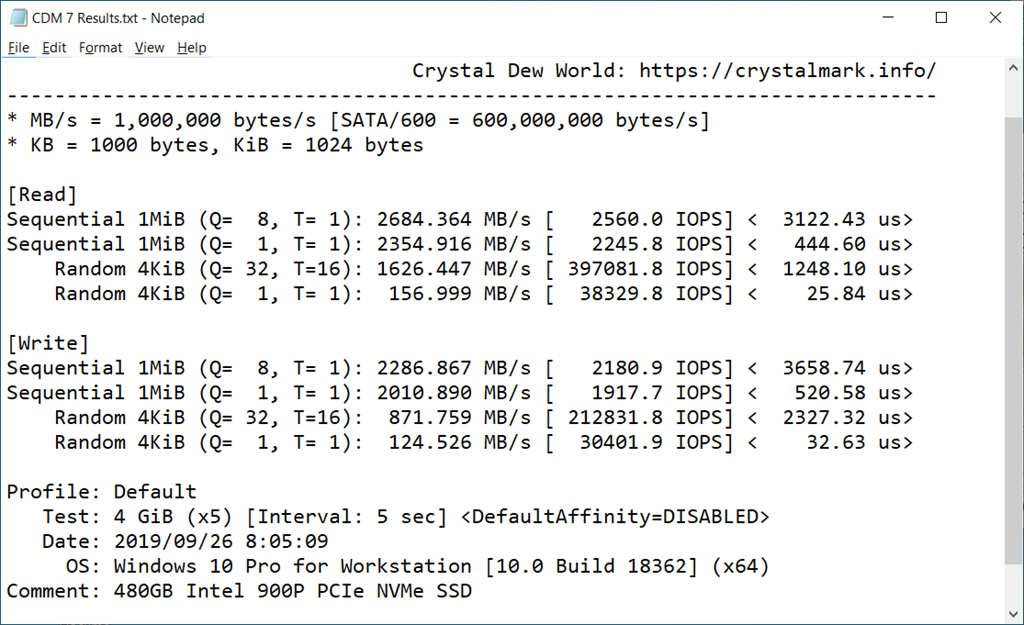
Figure 3: CrystalDiskMark 7 Text Results
This is one of the new testing profiles.
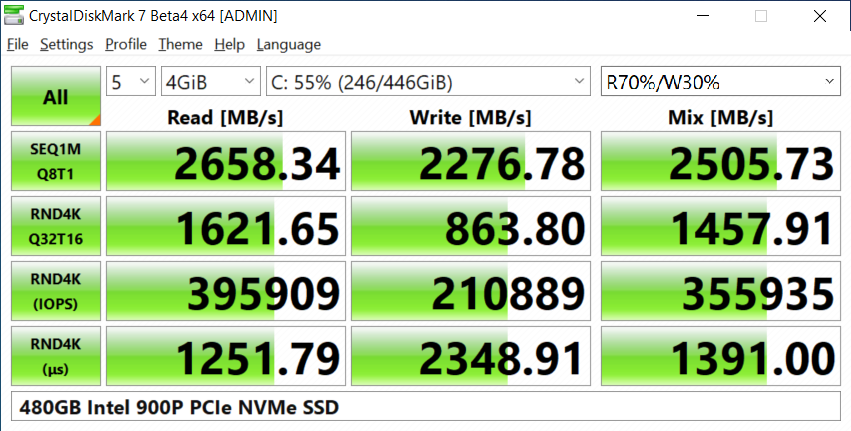
Figure 4: CrystalDiskMark 7.0 Beta4 – Peak Performance + Mix Profile
2nd Generation Intel Optane DC SSDs Coming in 2020
I’ve been very impressed with the 1st generation Intel Optane SSD DC P4800X “Coldstream” storage devices that use two-layer 3D XPoint media. They have been available since mid-2017, and they are extremely well-suited for certain types of SQL Server I/O workloads. One prime example is write heavy tempdb workloads.
Now, Intel is starting to reveal more details about the 2nd generation devices in this family. These are code named “Alder Stream”, and they will use Barlow Pass 3D XPoint media with four layers. It is also probable that they will have PCIe 4.0 support, and a new, faster controller. They are due for release in 2020, and they will have up to double the capacity and significantly better performance than the current generation.
One key advantage of these devices is that they will work with legacy versions of SQL Server and legacy hardware. As long as you have PCIe 3.0 x4 hardware support and your OS supports NVMe drivers, you can use them.
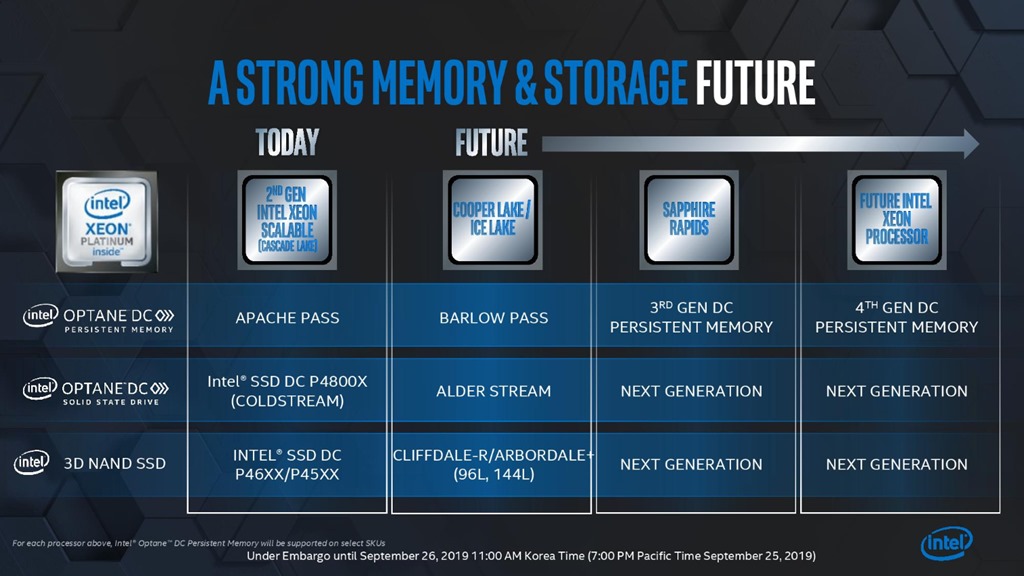
Figure 5: Intel Memory and Storage Roadmap
The post Glenn’s Technical Insights For September 26, 2019 appeared first on Glenn Berry.
]]>The post Glenn’s Technical Insights For September 13, 2019 appeared first on Glenn Berry.
]]>AMD Ryzen 3000 BIOS Fix
Over the last month or so, there has been a small controversy brewing in the hardware community about the maximum boost speeds for individual cores in AMD Ryzen 3000 series desktop processors. The allegation was that maximum boost speeds were sometimes 25-50 MHz below the rated maximum boost speed.
For example, the AMD Ryzen 7 3700X has a base clock speed of 3.6GHz and a Max Boost Clock of 4.4GHz. This is how AMD defines Max Boost Clock:
“Max boost for AMD Ryzen processors is the maximum frequency achievable by a single core on the processor running a bursty single-threaded workload. Max boost will vary based on several factors, including, but not limited to: thermal paste; system cooling; motherboard design and BIOS; the latest AMD chipset driver; and the latest OS updates.”
So, for example, people were seeing max boost speeds on the fastest core of a AMD Ryzen 7 3700X of perhaps 4350 or 4375 MHz instead of 4400 MHz. Not everyone was seeing this, but a significant number of people were seeing this issue. Just to be clear, this is not something you would notice in real life, but it was measurable in some benchmarks.
AMD has released a new AGESA version 1.0.0.3 ABBA to motherboard vendors that seems to improve this issue. Motherboard vendors should be releasing BIOS updates in the next 2-3 weeks. The reviews and benchmarks of the new BIOS I have seen typically are showing a single-threaded performance increase of 2-3%.
Here are the official AMD blog posts that cover this issue:
Ryzen Community Update: BIOS Updates for Boost and Idle, Plus a New SDK
Personally, I think this issue was blown way out of proportion. On the other hand, it is good that AMD addressed it pretty quickly. If you take the time to get everything updated, you will get a small performance increase for free.
If you want the best performance possible from your AMD Ryzen 3000 system, you need to do several things:
- Make sure you are on Windows 10 Version 1903
- This gives you a scheduler update so that Windows will favor the fastest core on your processor
- It partially enables UEFI CPPC support (so that clock speed increases more quickly)
- Make sure you are on the latest AMD chipset drivers
- This gives you the UEFI CPPC support in Windows 10 1903, and other improvements
- Make sure you update your BIOS
- AMD continues to make small improvements with each new AGESA version
September Release of Azure Data Studio
On September 10, 2019, Microsoft released the September version of Azure Data Studio, which is version 1.11.0. Microsoft continues to add new features to each release of Azure Data Studio. The release notes are here.
Some of the notable improvements include:
Enable SQLCMD Mode
Enable Community Extension: Query Editor Boost
Notebook Improvements
Visual Studio Code August Release Merge 1.38
Bug fixes
The post Glenn’s Technical Insights For September 13, 2019 appeared first on Glenn Berry.
]]>The post Glenn’s Technical Insights For August 25, 2019 appeared first on Glenn Berry.
]]>It also can just be technically related items that I find interesting.
SQL Server 2019 Release Candidate
On August 21, 2019, Microsoft announced the availability of the first public release candidate of SQL Server 2019. I find it interesting that Microsoft just called this “SQL Server 2019 Release Candidate” rather than Release Candidate 1 like they have done with previous versions of SQL Server. That sort of implies that there won’t be any more public release candidates before GA.
The looming question is when SQL Server 2019 will actually go GA. The conventional wisdom is that it will happen during the first week of November, while Microsoft Ignite (and PASS Summit 2019) are happening. It will probably be Wednesday, November 6, 2019, during the Day 1 Keynote Session at the PASS Summit. That is my guess.
Regardless of that, I think SQL Server 2019 is going to be a worthwhile release that should help convince more organizations to finally upgrade from their legacy versions of SQL Server.
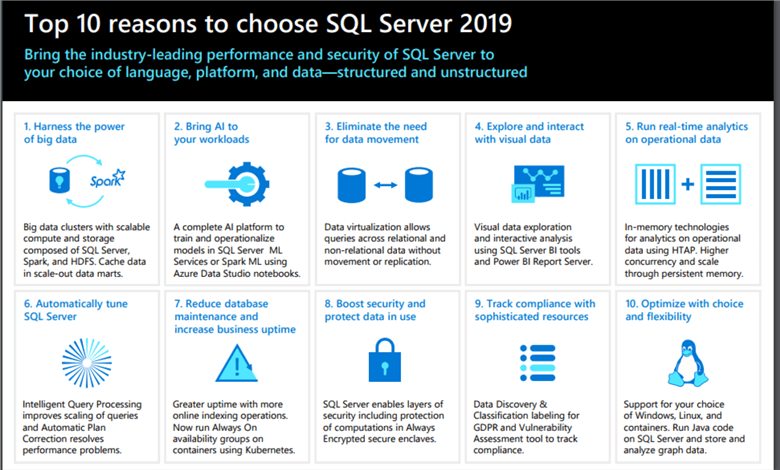
Figure 1: Top Ten Reasons to Choose SQL Server 2019
August 2019 Release of Azure Data Studio
On August 15, 2019, Microsoft released the August 2019 version of Azure Data Studio, which is version 1.10. Microsoft continues to maintain a monthly release cycle for Azure Data Studio. In my mind, this probably means that you should start using Azure Data Studio at least enough so that you are familiar with it.
I think it is going to be a tough “ask” for Microsoft to get veteran DBAs to completely switch to Azure Data Studio rather than using SSMS for most of their daily work. They would probably deny that is even their intent. At the same time, if SSMS is only updated every several months, and if Azure Data Studio continues to get new features to the point where it is seen as more useful than SSMS, then it may eventually become inevitable.
Don’t get me wrong, I am not hostile to Azure Data Studio. In fact, I plan on using it to present Dr. DMV’s Troubleshooting Toolkit at the PASS Summit 2019. I plan on building a SQL Notebook for that.
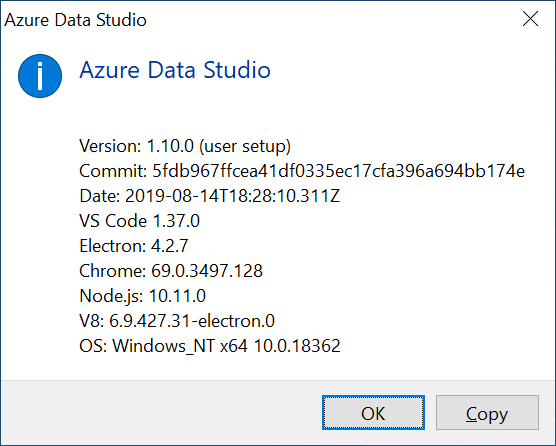
Figure 2: Azure Data Studio
The post Glenn’s Technical Insights For August 25, 2019 appeared first on Glenn Berry.
]]>The post Glenn’s Technical Insights For August 11, 2019 appeared first on Glenn Berry.
]]>AMD Releases EPYC 7002 Series Processors
On August 7, 2019, AMD finally unveiled their new 7nm EPYC 7002 Series server processors, formally code-named “Rome” at the AMD EPYC Horizon Event. This is the second generation EPYC server processor that uses the same Zen 2 architecture as the AMD Ryzen 3000 series desktop processors. These new processors are socket compatible with the previous generation AMD EPYC 7001 processors, but you will need a new model server to be able to leverage PCIe 4.0 support.
This new series includes 19 public launch SKUs that have anywhere from 8 physical cores to 64 physical cores. 2nd Generation AMD EPYC processors deliver up to 23% more instructions per clock (IPC) per core on server workloads and up to a 4X larger L3 cache compared to the previous generation AMD EPYC 7001 Series “Naples” processors.
There is already very broad industry support behind these new processors, with Dell EMC, HPE, Gigabyte, Lenovo, SuperMicro, and TYAN announcing new server models for these processors. Google is already using AMD EPYC 7002 processors for internal infrastructure workloads and will be offering virtual machines using these processors later in 2019. Microsoft is offering HBv2 virtual machines that will running on AMD EPYC 7002 series processors.
The initial reviews and benchmarks have been very impressive.
AMD EPYC 7002 Series Rome Delivers a Knockout
AMD Rome Second Generation EPYC Review: 2x 64-core Benchmarked
This processor series is going to have a huge impact on the server market. I’ll be writing a lot more about this in the future!
SQL Server 2016 and SQL Server 2017 Cumulative Updates
On July 31, 2019, Microsoft released SQL Server 2016 SP2 CU8 (Build 13.0.5426.0) which has 28 public hotfixes. If you are on SQL Server 2016, you really should be on the SP2 branch by now, especially since both the RTM and SP1 branches are no longer supported by Microsoft. If you are on the RTM or SP1 branch, you will have to install SP2, and then install the latest SP2 Cumulative Update to get fully up to date. I’ve already updated my blog post that highlights the more important hotfixes (in my opinion) for each CU in the SP2 branch.
Performance and Stability Related Fixes in Post-SQL Server 2016 SP2 Builds
On August 1, 2019, Microsoft released SQL Server 2017 CU16 (Build 14.0.3223.3) which has 39 public hotfixes. Starting with SQL Server 2017, Microsoft is not using Service Packs as a servicing mechanism for SQL Server, only Cumulative Updates. Microsoft has fixed hundreds of bugs since SQL Server 2017 RTM, and they have also added a significant number of product improvements and new features since the RTM release. I’ve already updated my blog post that highlights the more important hotfixes (in my opinion) for each SQL Server 2017 CU that has been released.
Performance and Stability Fixes in SQL Server 2017 CU Builds
You really are better off trying to stay as current as possible on your SQL Server builds. Here is Microsoft’s official guidance:
Microsoft recommends ongoing, proactive installation of CUs as they become available
- SQL Server CUs are certified to the same levels as Service Packs, and should be installed at the same level of confidence.
- Historical data shows that a significant number of support cases involve an issue that has already been addressed in a released CU.
- CUs may contain added value over and above hotfixes. This includes supportability, manageability, and reliability updates.
The post Glenn’s Technical Insights For August 11, 2019 appeared first on Glenn Berry.
]]>The post Glenn’s Technical Insights For July 29, 2019 appeared first on Glenn Berry.
]]>
SQL Server Management Studio 18.2 Released
On July 25, 2019, Microsoft released SQL Server Management Studio (SSMS) 18.2. This is mostly a bug fix release, but there are a few new features. These include:
- Intellisense support for the new OPTIMIZE_FOR_SEQUENTIAL_KEY option for indexes
- Added a completion time in messages to track when a query completed
- Added a new attribute in QueryPlan when the inline scalar UDF feature is enabled (ContainsInlineScalarTsqlUdfs)
- Added SMO support for Feature Restrictions. For more information on the feature itself, see Feature Restrictions
It is becoming more obvious that Microsoft is pushing Azure Data Studio as their preferred tool over SSMS. I don’t think SSMS is going to be abandoned any time soon, but it is clearly getting less love than Azure Data Studio.
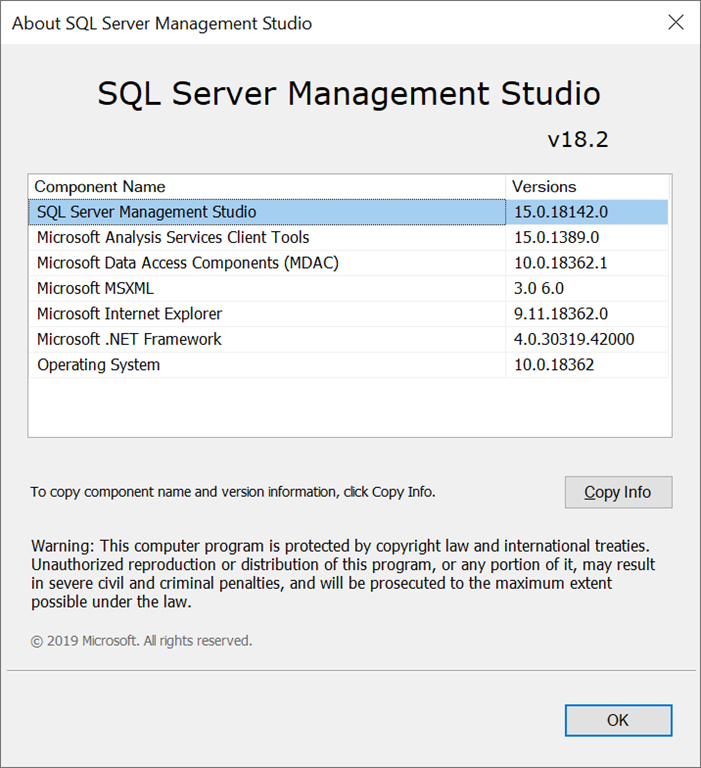
Figure 1: SSMS 18.2
The complete release notes are here. You can download SSMS 18.2 here.
SQL Server 2014 Cumulative Updates
Even though SQL Server 2014 fell out of mainstream support on July 9, 2019, there is actually one final set of Cumulative Updates for SQL Server 2014 that were released on July 29, 2019. These include:
SQL Server 2014 SP3 CU4 (Build 12.0.6329.1)
SQL Server 2014 SP2 CU18 (Build 12.0.5687.1)
There are four public hotfixes in SQL Server 2014 SP2 CU18, and there are nineteen public hotfixes in SQL Server 2019 SP3 CU4. If you are on SQL Server 2014, you should get on SQL Server 2014 SP3 CU4 eventually, since that is going to be the last released build (unless there are any security updates between now and July 9, 2024, which is pretty likely).
There are also probably going to be the latest round of Cumulative Updates for SQL Server 2016 and SQL Server 2017 later this week, so keep your eye out for that.
The post Glenn’s Technical Insights For July 29, 2019 appeared first on Glenn Berry.
]]>