The post Some Comparative CPU-Z Benchmark Scores appeared first on Glenn Berry.
]]>I previously promised some benchmarks on the new system, so one very quick and easy one is the CPU-Z benchmark. This test only takes about 15 seconds, and it is part of the very useful CPU-Z utility, which requires no installation. This makes it very easy to run on a system, whether it is a gaming rig or a VM that will be running SQL Server. Figure 1 shows an example result on my AMD Ryzen Threadripper 2950X workstation.
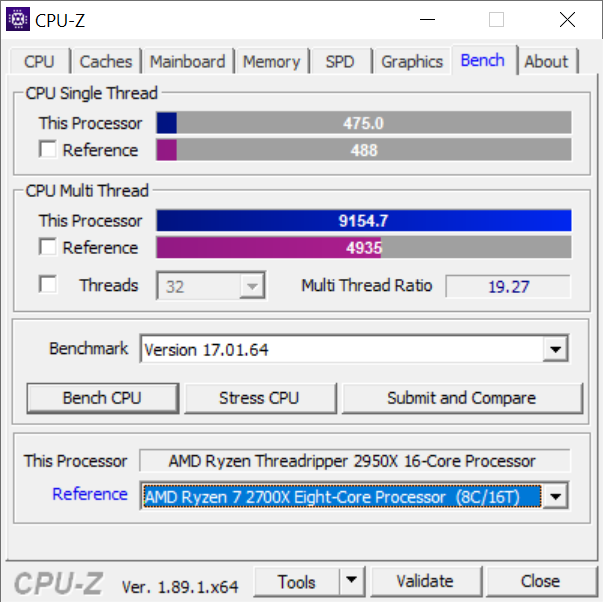
Figure 1: Example CPU-Z Benchmark Results
Today, I decided to run the CPU-Z 1.89.1 CPU benchmark on eight different systems that I have around the house. Two of these are high-end desktops (HEDT), three are mainstream desktops, and three are laptops. The ST Score is the single-threaded score, while the MT score is the multi-threaded score.
The oldest system in the bunch is the 14nm Intel Core i7-6700K from Q3 2015, while the newest is the 7nm AMD Ryzen R7-3700X from Q3 2019. My AMD Ryzen Threadripper systems don’t quite have the same single-threaded CPU performance as the mainstream desktop systems, but they do have a lot more cores (and PCIe 3.0 lanes).
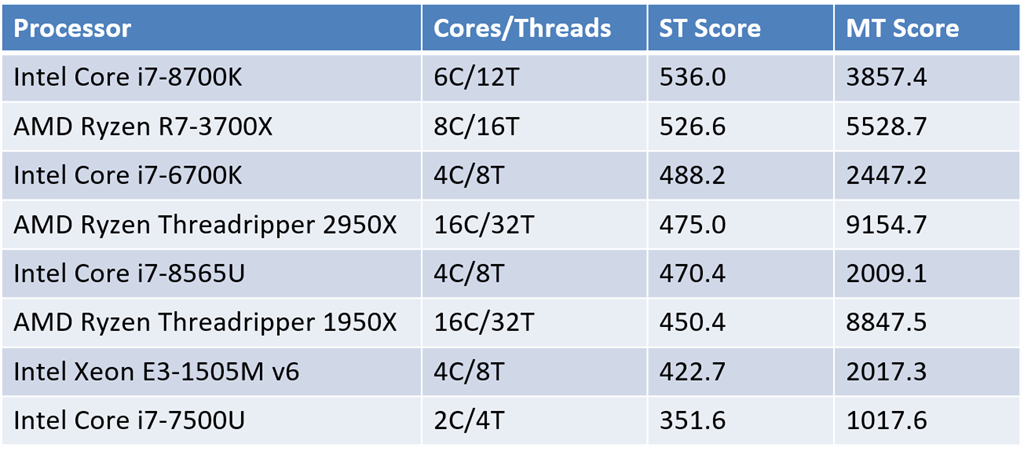
Figure 2: Comparative CPU-Z Benchmark Scores
None of these systems are the current “top of the line” anymore. The AMD Ryzen R7-3700X is roughly in the middle of the stack for the AMD Ryzen 3000 series. The value proposition of the AMD Ryzen 3000 series is that you get great multi-threaded CPU performance, and close enough single-threaded CPU performance for significantly less money than comparable Intel mainstream desktop processors. You also get PCIe 4.0 support with an X570 motherboard.
Rumor has it that AMD may introduce the 3rd generation Ryzen Threadripper processors as soon as September 7, 2019, supposedly with new X599 motherboards to enable PCIe 4.0 support.
The post Some Comparative CPU-Z Benchmark Scores appeared first on Glenn Berry.
]]>The post New Benchmark Feature in CPU-Z 1.73 appeared first on Glenn Berry.
]]>You can also run a CPU stress test, that will peg all of your CPU cores at 100% CPU utilization until you stop the test. This is useful for seeing whether Intel Turbo Boost is in effect or whether it is not being used due to some form of power management.
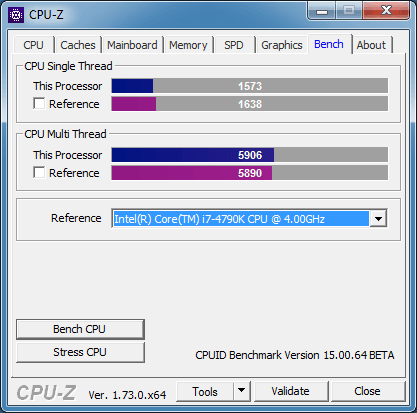
Figure 1: CPUID Benchmark results for over-clocked Intel Core i7-3770K
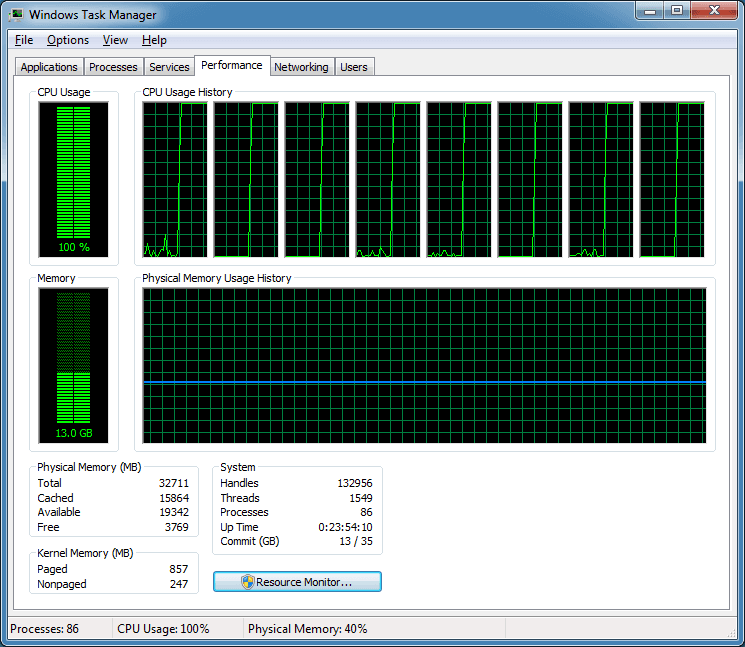
Figure 2: Windows 7 Task Manager after starting Stress CPU
Just for fun, I grabbed the same information from my World of Tanks gaming rig (which has a slightly over-clocked Intel Core i7-4790K processor), as shown below.

Figure 3: CPUID Benchmark results for over-clocked Intel Core i7-4790K

Figure 4: Windows 10 Task Manager after starting Stress CPU
The post New Benchmark Feature in CPU-Z 1.73 appeared first on Glenn Berry.
]]>The post Windows Power Plan Effects on Newer Intel Processors appeared first on Glenn Berry.
]]>This server had a new, default installation of Windows Server 2012 R2 Standard Edition, which meant that it was using the default Windows Balanced Power Plan. Running CPU-Z 1.71.1 showed the actual core speed of Core #0 while the system was at rest, with the Balanced Power Plan (Figure 1) and with the High Performance Power Plan (Figure 2).
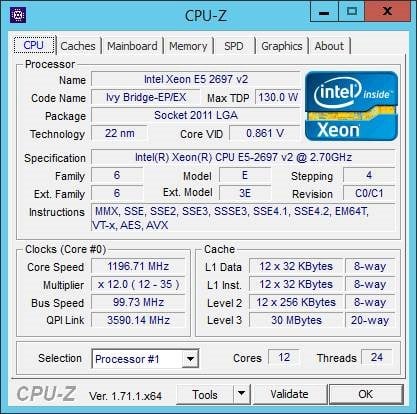
Figure 1: CPU-Z Results with Balanced Power Plan
Changing the Power Plan to High Performance had an immediate effect on the processor core speed, as shown in Figure 2.
![clip_image002[5]](https://www.sqlskills.com/blogs/glenn/wp-content/uploads/2015/02/clip_image0025.jpg "clip_image002[5]")
Figure 2: CPU-Z Results with High Performance Power Plan
Here are the Geekbench results for the default Balanced Power Plan (Figure 3) and the High Performance Power Plan (Figure 4). The Single-Core score is more relevant here, since the 32-bit GUI version of Geekbench 3.3 only uses 32 total cores (and there are 48 logical cores in this server).
![clip_image002[7]](https://www.sqlskills.com/blogs/glenn/wp-content/uploads/2015/02/clip_image0027.jpg "clip_image002[7]")
Figure 3: Geekbench 3.3 Results with Balanced Power Plan
![clip_image002[9]](https://www.sqlskills.com/blogs/glenn/wp-content/uploads/2015/02/clip_image0029.jpg "clip_image002[9]")
Figure 4: Geekbench 3.3 Results with High Performance Power Plan
You need to keep in mind that your BIOS power management settings will override your Windows Power Plan settings, so it is very important to check what is going on with CPU-Z. For you virtualization users, you need to check what your hypervisor power management settings are doing, because they will override what is happening with the guest OS Windows Power Plan settings.
Not only does power management affect your processor core speed (and CPU/memory benchmarks like Geekbench), but it also affects things like the performance of your PCIe expansion slots. In case you want some official Microsoft guidance on this subject, the Microsoft KB article linked below discusses it in quite a bit of detail.
Slow Performance on Windows Server 2008 R2 when using the “Balanced” Power Plan
This issue has been around since Windows Server 2008, and still exists with Windows Server 2012 R2.
The post Windows Power Plan Effects on Newer Intel Processors appeared first on Glenn Berry.
]]>The post CPU-Z Version 1.67 is Available appeared first on Glenn Berry.
]]>This can be caused by your Windows Power Plan in Windows Server 2008 or newer. By default, the Power Plan is set to Balanced instead of High Performance like we want for a database server. This is easy to change, and goes into effect immediately without rebooting the server. After you make this change in Windows, you should use CPU-Z to see what your processor core speed is. If it is still throttled back, you are going to have to change your BIOS power management setting.
This is necessary because the Windows Power Plan can be overridden by hardware-level power management settings that are set in your main BIOS setup. You typically want to set your hardware-level power management to OS Control or to Max Performance in the BIOS. This will let your processors take advantage of Intel Turbo Boost or AMD Turbo Core, and it will let them run at their full base clock speed or above at all times. This is quite important for OLTP query performance, but have also seen it affect ETL performance. Many storage vendors, such as Fusion-io and LSI also recommend that you make these changes to avoid having the PCI-E expansion slots affected by power management.
Figure 1 shows my desktop processor running at full speed with Turbo Boost (see the Core Speed indicator at the bottom left quarter of the form), while Figure 2 shows the processor being throttled back due to power management.
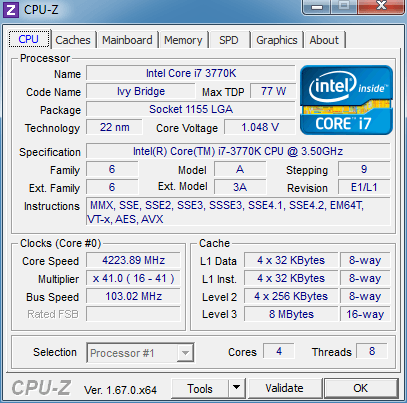
Figure 1: Processor Core Speed without any Power Management
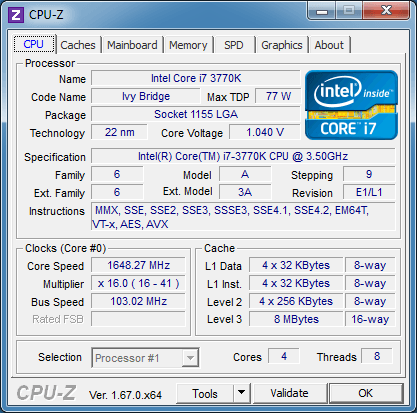
Figure 2: Processor Core Speed with Power Management in Effect
I have seen OLTP query performance improve by as much as 25% by making these simple changes. The level of improvement you will see depends on the exact processors you are using (newer processors like Haswell, Ivy Bridge, and Sandy Bridge handle power management better than older processors, such as Nehalem and Westmere), and whether or not you have other big performance bottlenecks.
The post CPU-Z Version 1.67 is Available appeared first on Glenn Berry.
]]>The post New Versions of Useful Tools for SQL Server appeared first on Glenn Berry.
]]>Geekbench 3 is Primate Labs’ next-generation processor benchmark, with a new scoring system that separates single-core and multi-core performance, and new workloads that simulate real-world scenarios. Geekbench 3 makes it easier than ever to find out if your computer is up to speed.
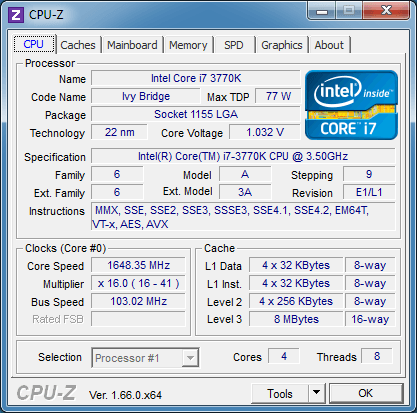
There is also a new 1.66 version of CPU-Z, that has support for some upcoming processors, such as the Intel Xeon E5-2600 v2 series (Ivy Bridge-EP).
The post New Versions of Useful Tools for SQL Server appeared first on Glenn Berry.
]]>The post A SQL Server Hardware Tidbit a Day – Day 27 appeared first on Glenn Berry.
]]>Power Management is when the clock speed of your processors is reduced (usually by changing the processor multiplier value) in order to use less electrical power when the processor is not under a heavy load. On the surface, this seems like a good idea, since electrical power costs can be pretty significant in a data center. Throttling back a processor can save some electricity and reduce your heat output, which can reduce your cooling costs in a data center. Unfortunately, with some processors, and with some types of SQL Server workloads (particularly OLTP workloads), you will pay a pretty significant performance price (in the range of 20-25%) for those electrical power savings.
When a processor has power management features that are enabled, the clock speed of the processor will vary based on the load the processor is experiencing. You can watch this in near real-time with a tool like CPU-Z, that displays the current clock speed of Core 0. The performance problem comes from the fact that some processors don’t seem to react fast enough to an increase in load to give their full performance potential, particularly for very short OLTP queries that often execute in a few milliseconds.
This problem seems to show up especially with Intel Xeon 5500, 7500 (Nehalem-EP and EX), Intel Xeon 5600, E7 series processors (Westmere-EP and EX families) and with the AMD Opteron 6100, 6200, and 6300 series (Magny Cours, Bulldozer and Piledriver families). Much older processors don’t have any power management features, and some slightly older processors (such as the Intel Xeon 5300 and 5400 series) seem to handle power management slightly better. I have also noticed that the Intel Sandy Bridge-EP processors seem to handle power management a little better than the Nehalem and Westmere did, i.e. they don’t show as noticeable of a performance decrease when power management is enabled.
Basically, you have two types of power management that you need to be aware of as a database professional. The first type is hardware-based power management, where the main system BIOS of a server is set to allow the processors to manage their own power states, based on the load they are seeing from the operating system. The second type is software-based power management, where the operating system (with Windows Server 2008 and above) is in charge of power management using one of the standard Windows Power Plans, or a customized version of one of those plans. When you install Windows Server 2008 or above, Windows will be using the Balanced Power Plan by default. When you are using the Balanced Power Plan, Intel processors that have Turbo Boost Technology will not use Turbo Boost (meaning that they will not temporarily overclock individual processor cores for more performance).
So, after all of this, what do I recommend you do for your database server? First, check your Windows Power Plan setting, and make sure you are using the High Performance Power Plan. This can be changed dynamically without a restart. Next, run CPU-Z, and make sure your processor is running at or above its rated speed. If it is running at less than its rated speed with the High Performance Power Plan, that means that you have hardware power management overriding what Windows has asked for. That means you are going to have to restart your server (in your next maintenance window) and go into your BIOS settings and either disable power management or set it to OS control (which I prefer).
The post A SQL Server Hardware Tidbit a Day – Day 27 appeared first on Glenn Berry.
]]>The post A SQL Server Hardware Tidbit a Day – Day 5 appeared first on Glenn Berry.
]]>This tool will give you a great amount of detail about your processor(s), caches, motherboard, and memory, among other things. The CPU tab is shown in Figure 1.
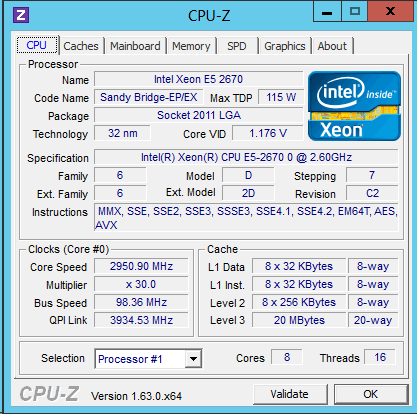
Figure 1: CPU tab of CPU-Z 1.63
For example, Figure 1 shows that I have a 32nm, Intel Xeon E5-2670 (Sandy Bridge-EP), that has a rated base clock speed of 2.60GHz, but it is actually running at 2.95GHz. This shows that the processor is running at full speed, with Turbo Boost increasing the speed to 2.95Ghz (at least on Core 0 of Processor #1). It is possible, and actually quite common for people to see that their processor is running at a much lower speed than its rated based clock speed, due to either the current Windows Power Plan that is in use on the operating system, or because of the hardware power management settings in the BIOS setup. As a database professional, this is something you would want to investigate and correct.
The CPU tab also shows that this processor is x64 compatible, since we see EM64T as one of the supported instructions. We can also see the size and types of the L1, L2, and L3 caches. Finally, I can see that this processor has eight cores and sixteen threads, which means that it has hyper-threading, and hyper-threading is enabled.
The Caches tab shown in Figure 2 gives you a lot of more detailed information about the L1, L2 and L3 caches.
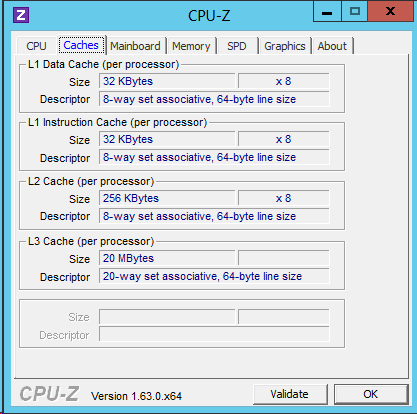
Figure 2: Caches tab of CPU-Z 1.63
The Mainboard tab shown in Figure 3 gives you a lot of useful information about the motherboard, chipset, and main BIOS version.
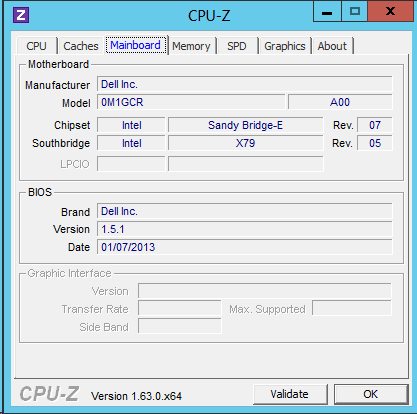
Figure 3: Mainboard tab of CPU-Z 1.63
Figures 4 and 5 show the Memory and Serial Presence Detect (SPD) tabs of CPU-Z, which give you very useful information about the type and amount of memory that you have in your machine. In this case, we can see that we have 65460 MBytes of DDR3 RAM, (which is 64GB), and it is running in Quad channel mode.
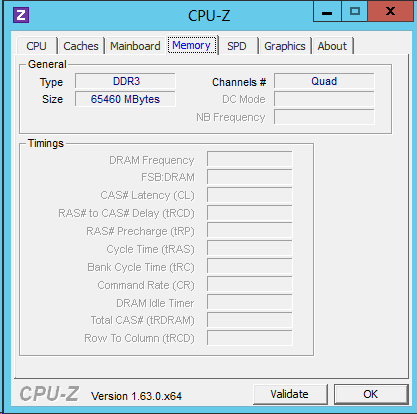
Figure 4: Memory tab of CPU-Z 1.63
On some machines, the SPD tab will be blank. This seems to depend on the type and age of your machine, and the version of CPU-Z that you are using. Sometimes, you can better results for your machine when a new version of CPU-Z is released. In this case, we are getting complete information about the exact type and size of the memory modules that are in each slot of the Dell PowerEdge R720 machine, as shown in Figure 5.
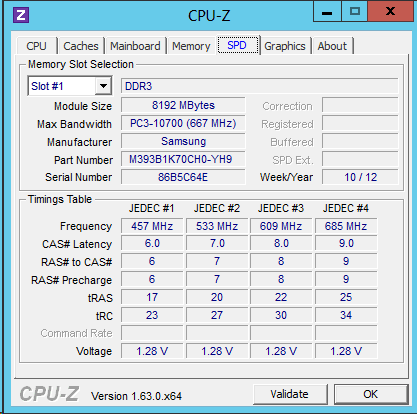
Figure 5: SPD tab of CPU-Z 1.63
Over the many times that I have talked about using CPU-Z, I have gotten a few questions about whether it is safe to run on a production SQL Server. All I can say is that I have been using it myself for many years, with absolutely no problems. Many other well-known people in the SQL Server community have been doing the same thing. I think it is an extremely valuable tool for confirming some important information about the processors in your database servers.
If you don’t feel comfortable using this tool, then don’t use it…
The post A SQL Server Hardware Tidbit a Day – Day 5 appeared first on Glenn Berry.
]]>